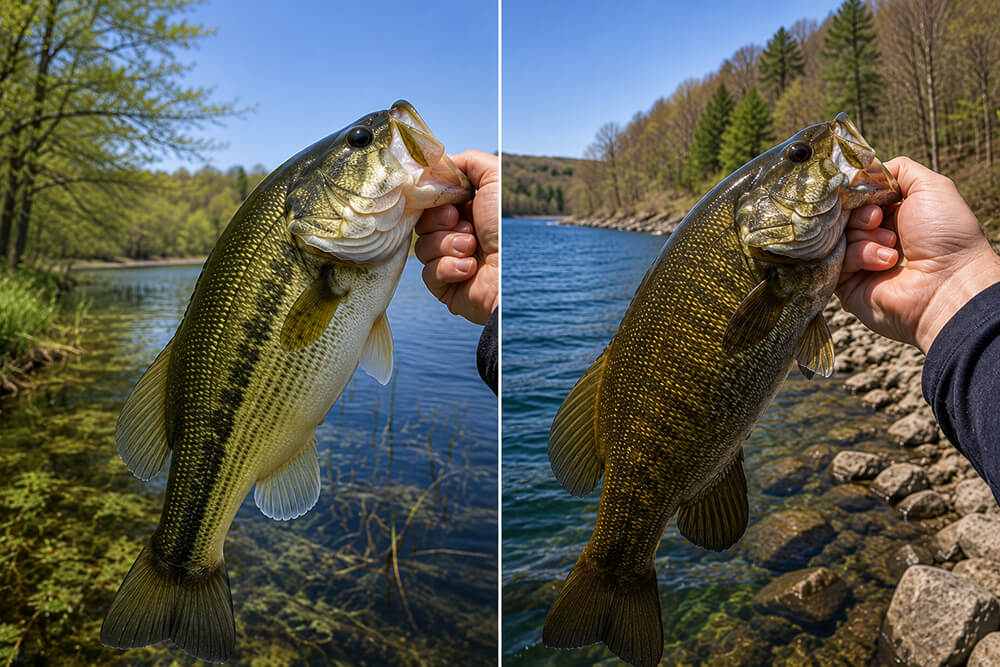
Spring is one of the most interesting times to fish for bass in the Northeast because largemouth and smallmouth do not behave the same way. They may share the same season, but they usually use different water, respond to different temperatures, and often need a different approach from the angler.
State fishery guidance in New York and Massachusetts also reflects those differences, especially in where each species holds and how anglers typically target them.
If you are planning bass fishing northeast waters in spring, the easiest way to think about it is this:
Largemouth usually relate more to shallow cover and emerging weeds, while smallmouth more often hold around rock, gravel, points, and clearer water.
The biggest difference starts with habitat
Northern smallmouth are different. In spring, they are more likely to show up around rocky banks, gravel areas, points, current seams, and clearer lakes or rivers. New York specifically says smallmouth prefer rocky areas of lakes and rivers and are commonly found in a wider depth range than largemouth.
So, if you pull up to a Northeast lake in spring, a simple rule helps:
- See weeds, wood, pads, and calm shallows? Start thinking largemouth.
- See rock, gravel, clearer water, and wind-blown points? Start thinking smallmouth.
They also move on different spring schedules
Both species become more active as water warms, but smallmouth often stay comfortable in cooler water longer, while largemouth really turn on as shallow water warms up.
Massachusetts notes that spring is the time to target pre-spawn bass when they are actively feeding, and both species become easier to pattern as they move toward spawning areas.
In practical terms, that often means:
Largemouth in spring
Smallmouth in spring
The bite usually feels different too
Largemouth bites in spring often come around cover and can feel heavy, soft, or sudden, especially on slower presentations like soft plastics or jigs.
Smallmouth bites are often sharper and more aggressive, especially when fish are roaming rock or chasing bait in clearer water. They are also known for fighting harder relative to size. New York describes smallmouth as one of the hardest-fighting freshwater fish.
What lures usually make more sense?
Better starting points for largemouth
- soft stickbaits
- jigs
- spinnerbaits
- Texas rigs
- chatter-style moving baits around emerging grass or wood
These work well because they can be fished around cover and through shallower zones where largemouth often hold in spring. Massachusetts and New York both recommend working weed edges, shallow cover, and structure methodically.
Better starting points for smallmouth
- Ned rigs
- tube jigs
- suspending jerkbaits
- finesse worms
- small swimbaits around rock and drop-offs
New York’s bass guidance specifically highlights techniques like the Ned rig for deeper, clearer water around rocks, which lines up well with classic spring smallmouth patterns.
A common mistake anglers make in the Northeast
If you keep casting a smallmouth pattern into shallow weedy water, you may miss active largemouth. If you only flip shoreline cover on a clear rocky lake, you may pass right by the better smallmouth setup.
Another mistake is ignoring how much spring changes from one week to the next. In the Northeast, water temperatures can swing fast, and fish can move from staging to feeding to spawning zones quickly. That is one reason many anglers keep up with northeast bass fishing reports before they go. Current reports can help you see whether fish are still staging, moving shallow, or already locked into a more defined spring pattern.
The legal side matters in spring
There is no single Northeast-wide bass law. Regulations vary by state and sometimes by individual waterbody. For example:
- New York statewide rules list black bass harvest from June 15 to November 30 with a 12-inch minimum and 5-fish daily limit, and from December 1 to June 14 the statewide rule is catch-and-release only with artificial lures only, though special regulations can apply on some waters.
- Massachusetts lists black bass as open January 1 to December 31 with a 12-inch minimum and 5-fish limit.
- Maine uses statewide freshwater laws plus special water-specific rules, so anglers need to check the law book and the exact water they plan to fish.
That means before booking northeast bass fishing trips, you should always confirm:
- whether catch-and-release rules apply
- whether artificial-only rules are in effect
- minimum size and daily limit
- whether your lake or river has special regulations
- license requirements for that state
Which one is easier to catch in spring?
- Largemouth can feel easier when fish are shallow and relating tightly to visible cover.
- Smallmouth can be easier when fish are grouped on rock and actively feeding in stable spring weather.
A lot depends on the waterbody. On a weedy pond, largemouth may clearly be the better target. On a clear rocky lake, smallmouth may be the more predictable spring fish.
Which one should you target on your trip?
Choose largemouth if you enjoy picking apart cover, fishing shallows, and working around grass, docks, and wood.
Choose smallmouth if you like rocky structure, clearer water, and a more roaming fish that often hits with speed and fights hard.
For many anglers interested in northeast bass fishing, the best answer is not choosing one over the other. It is learning how each species uses spring differently so you can adjust faster when conditions change.
If you want a broader seasonal overview, read our article on What is the Best Time to Catch bass fishing in Northeast?
Conclusion
If you are planning to fish this season and want help narrowing down timing, locations, and patterns, connect with northeast bass fishing guides for more informed bass fishing northeast trips and current regional insight.